
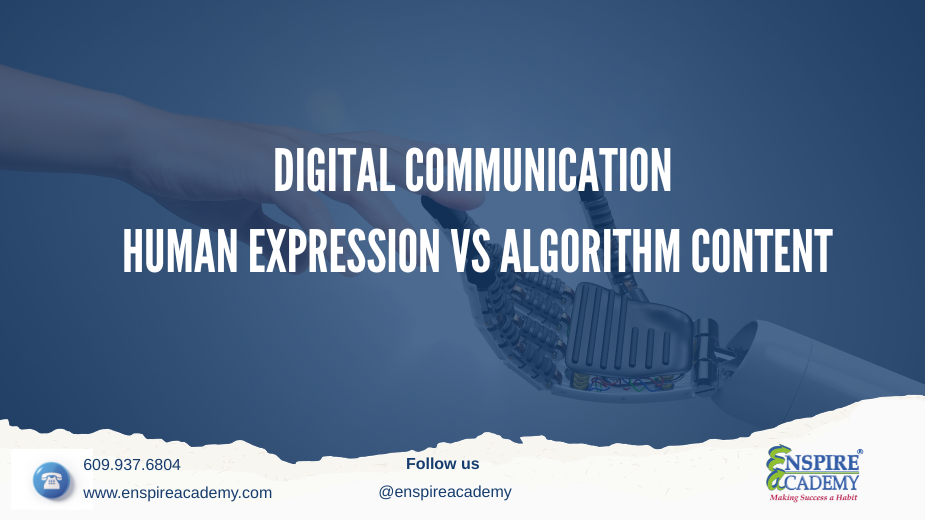
Today, human expression and digital UX are in a war, causing a mass extinction of nuance. This shift is happening across modern digital communication platforms.
Last week, between meetings, I was scrolling LinkedIn when I noticed something unsettling in the way digital communication is evolving. Post after post looked like the same invisible author wrote them:
A short opening line… mostly contrarian.
A generic lesson in a “Universal Truth” tone
A binary statement about a concept.
The bulleted list
A tidy question at the end.
This pattern is becoming common in today’s digital communication landscape.
I read each in seconds and understood them instantly. Yet, I felt absolutely nothing. I realized something was missing: the soul. That emptiness is quietly spreading across digital communication today.
Having studied human connection for 30 years, I get it. Whether you are a recent grad building a network or a CEO scaling a brand, writing in short, punchy sentences is an incredibly effective way to survive the mobile scroll in modern digital communication. But I also deeply care about what gets lost when we trade natural language for an algorithm-friendly rhythm.
The Death of Flow
A “wall of text” intimidates mobile readers. So, we adapted. Short, punchy sentences replaced the classic style and won. While AI didn’t invent this choppy ‘Broetry’ style, it made it endlessly scalable across digital communication channels.
In our quest to beat the algorithm, we started to sound like one. This is becoming a defining problem in digital communication today.
This is a tragedy. I grew up in a household where the Oxford Dictionary was the Bible and Wren & Martin was gospel. During long bus rides, my father drilled me on grammar, teaching me that conjunctions are the connective tissue of thought. “A sentence must have a structure,” he’d say. “It needs a soul.” That philosophy shaped how I view meaningful digital communication.
Today, we’ve stripped away the soul. We don’t write sentences that meander or explore; we write code. This mechanical pattern now dominates much of digital communication.
Input: Reactive leader.
Output: Reactive culture.
Posts sound like a GPS:
“Threat detection rises.
Working memory shrinks.
Time horizon shortens.”
This robotic tone is slowly redefining the nature of digital communication.
When we write only in three-word bursts, we destroy flow and the deep satisfaction of communicating through a well-shaped paragraph.
But what scares me most is that when a society changes its writing style, it changes its thinking style. We begin treating human behavior like binary logic: If X happens, then Y results. We stop thinking in complex layers, ignoring the gray areas of real life. This shift is already visible in modern digital communication.
Life isn’t binary.
The Rebellion: How to Be Human Again
You don’t need to write dense academic papers to sound smart. There is a middle path to gaining high engagement without sounding like a chatbot, even within fast-moving digital communication environments.
Here are three strategic shifts to reclaim your voice and make your writing undeniably human in today’s digital communication world:
1. Trade “Universal Truths” for Lived Experience:
Algorithms and AI models speak with absolute certainty. They eliminate ambiguity to sound authoritative. But human credibility stems from nuance and context.
The Fix: Stop declaring rules. Use softening language (“In my experience,” “I’ve noticed,” “Often”) to frame the narrative around how you learned it.
Instead of: “Failure is learning.”
Say: “In my career, the most painful missteps usually preceded my biggest leaps.” By opening a window into your reality, you become undeniably human. Your peers will connect with you more deeply through digital communication.
2. Avoid Stacking “Abstract Nouns.”
Algorithms understand concepts, not concrete moments. And when we are constantly fed this optimized, data-driven content, we inadvertently adopt its sterile vocabulary. We describe the human experience using mechanical jargon: “Neural state.” “Regulated resource.” “Resilient system.”
None of these is wrong. But when you stack them together without anchoring them to a vivid, real-world scene, your writing loses its heartbeat. It starts sounding like a template often seen in digital communication.
The Fix: Strip the clinical, corporate vocabulary. Talk about the very real anxiety of making a hard decision when you are exhausted. Speak to the human condition, not the machine.
3. Embrace the “Messy Middle” (Ditch Binary Logic)
The ‘Broetry’ style reduces complex human dynamics to basic, if/then equations. But today’s real-world challenges are agonizingly difficult to solve, and a formulaic solution is misleading in real digital communication.
The Fix: Lean into the gray areas. When you admit that a leadership challenge is messy and doesn’t have a perfect, bullet-proof solution, you immediately signal to the reader: “I have actually been in the trenches, and I know how hard this is.”
The “9-Word” Challenge For You
Here is an invitation for your next post. Stop writing for the algorithm and start writing for your peers through authentic digital communication.
Human Communication
Your challenge: Ensure at least two sentences in your next post are longer than 9 words. Use them to add color, emotion, or the messy context of real life.
You are a guardian of your language. You decide if the future of communication should be a series of robotic bleeps or a rich, messy, beautiful symphony of ideas within digital communication.
Be brave enough to use a semicolon. Be brave enough to write a paragraph.
Be human. The algorithm will adjust to us if we refuse to adjust to it.