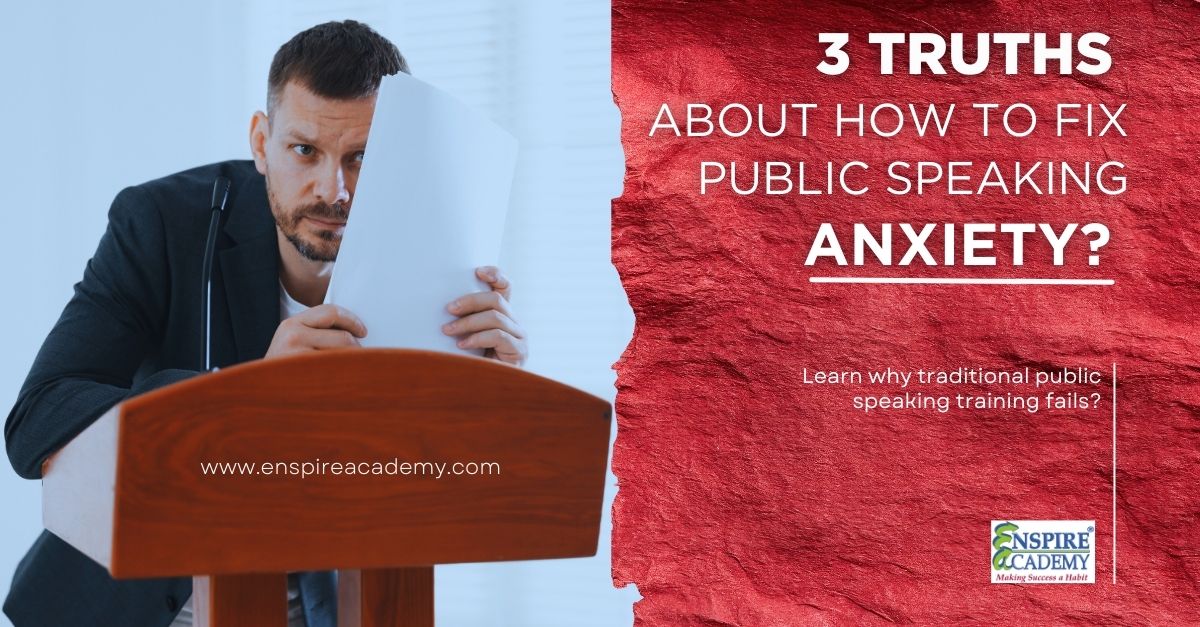
Here is the question most people never ask: Why does your body react to a conference room or a classroom as if it were a tiger in the jungle?
Think of a time when your name was called, and the room went quiet.
You stood up. Suddenly, your palms sweat, your heart hammered against your ribs, and the brilliant ideas you had two minutes ago vanish. You go blank.
If this sounds familiar, welcome to the human race. Depending on how researchers ask the question, roughly 40% to 75% of people report significant fear of public speaking.
Why Traditional Public Speaking Training Fails
For a long time, public speaking anxiety was explained as pure biology. Your body senses threat, and it prepares you to survive. But a classroom isn’t a threat. A boardroom isn’t a predator. So why do you react like it is?
Recent research suggests fear of public speaking has a cognitive component. Your brain isn’t scared of people. It’s scared of judgment – More specifically, it’s scared of what you think the audience’s faces mean..
-
- “Are they judging me?”
-
- “If I mess up, I’ll look stupid.”
-
- “If I pause, they’ll think I’m clueless.”
That interpretation drives anxiety more than the audience does. Researchers often call this performance orientation. It’s the belief that “If I’m not perfect, I’m done.”
Many traditional public speaking training programs accidentally make anxiety worse. They obsessively focus on “choreographed” movements and delivery, teaching you to “perform” speaking instead of communicating.
“Stand here. Gesture now. Pause exactly three seconds. Lower your voice here. Smile there….”
This approach forces you to run a mental checklist while speaking. It creates cognitive overload. It’s like driving while staring at the dashboard. You’ll most likely crash because your attention is in the wrong place. Recent studies on “Communication Orientation Motivation” (COM) therapy show that speakers who view their task as a “performance” consistently report higher anxiety levels than those who view it as a “conversation.”
Anxiety loves self-focus. The more you monitor yourself, the more nervous you get.
3 Tips to Overcome the Fear of Public Speaking
If you want to overcome the fear of public speaking for the long term, you don’t need better hand gestures. You need a better mindset.
1) Trade Perfection for Connection
The speakers people remember are rarely perfect. They are human. A 2020 study analyzed 1,095 TED Talks and found that when your tone is authentic, warm, clear, and story-driven, people listen longer and trust faster.
Perfection is impressive for five seconds. Connection lasts.
2) Use Safe Exposure
You cannot learn to swim by watching YouTube videos about swimming. You learn by getting in the water.
Same with speaking. Evidence-based approaches like Cognitive Behavioral Therapy (CBT) consistently rely on gradual exposure. Speak, fail, adjust, repeat. But it has to happen in a psychologically safe environment, where mistakes cost you nothing.
3) Focus on the Gift, Not the Wrapper
Delivery matters. A sloppy delivery can be distracting, just like a dirty wrapper makes people hesitate to open a gift. But, when you obsess over “choreography,” —the hand gestures, the stance, the vocal tricks, you forget the real gift inside—your authentic message. Focus on internalizing the message; the delivery becomes natural; it becomes the vehicle for your value, not a mask to hide behind.
How to Build Public Speaking Skills, Long-Term
If you are looking for training for yourself or your child, be wary of programs that promise “instant confidence” through tips and tricks. Confidence is a muscle, not a mood. It is built through substance over style, connection over choreography—is exactly how we train at Enspire Academy.
-
- We don’t lecture our students on how to stand; we put them in scenarios where they have to stand up.
-
- We don’t give them scripts; we give them problems to solve out loud.
Whether you’re a student or an executive, the goal is the same: build the muscle in a safe place, so you can discover a speaking style that is uniquely, authentically yours and show up strong when it counts.
The world doesn’t need another polished robot. It needs you, fully present, fully human, and fully heard.